
By William Collins, consultant in stock markets – Eurasia Business News, October 17, 2026. Article no 3213
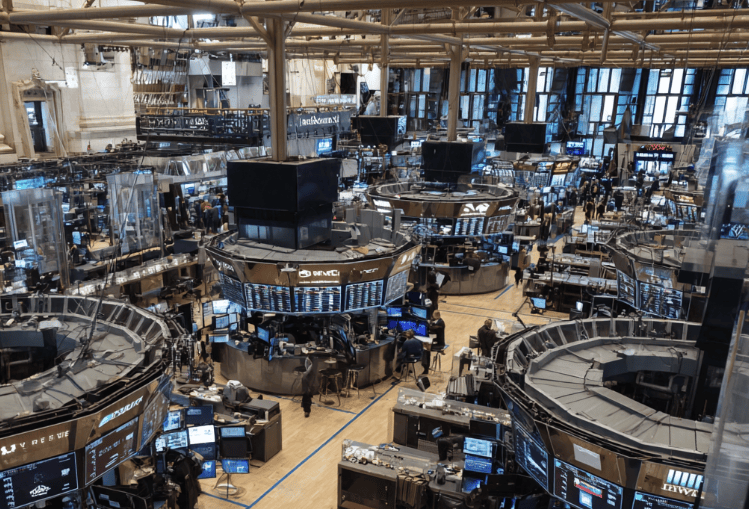
U.S. stock markets fell sharply on Friday, October 16, as mounting concerns about artificial-intelligence financing spread from CoreWeave to major technology companies including Alphabet. The Nasdaq Composite dropped 2.1%, while the S&P 500 lost 1.1%, completing their worst weekly performances since June. The Dow Jones Industrial Average declined a more modest 0.3%.
The selloff marked a change in the market’s debate. Investors were no longer focused only on how much AI demand could grow, but also on whether companies could earn sufficient returns on enormous infrastructure investments. Expensive borrowing, persistent inflation and another jump in oil prices intensified those concerns.
Dow, Nasdaq and S&P 500 Performance
The Nasdaq Composite fell 572.99 points to close at 26,140.03. The S&P 500 dropped 84.62 points to 7,659.44, while the Dow surrendered 175.28 points to finish at 52,002.41.
| U.S. stock index | October 16 close | Friday change | Weekly change |
|---|---|---|---|
| Dow Jones Industrial Average | 52,002.41 | -0.3% | +0.7% |
| S&P 500 | 7,659.44 | -1.1% | Approximately -2.0% |
| Nasdaq Composite | 26,140.03 | -2.1% | -4.5% |
The Nasdaq’s weekly decline ended a four-week winning streak. The Dow, by contrast, recorded a second consecutive weekly gain, showing that selling was concentrated in growth stocks rather than uniformly distributed across the market.
Why the AI Trade Is Under Pressure
AI infrastructure requires substantial spending on chips, data centers, networking equipment and electricity. Investors increasingly questioned whether revenues and profits would justify that spending, particularly for businesses dependent on debt financing.
CoreWeave became the clearest expression of those concerns. Its shares fell 12% on Friday as attention returned to its borrowing-heavy business model. Bloomberg reported that its bonds had recently traded at levels typically associated with financial distress. That indicates elevated investor concern, not confirmation of default.
Higher interest rates create two problems for these companies: they increase financing costs while reducing the present value investors assign to future profits. Strong underlying demand for computing capacity therefore does not automatically translate into attractive investment returns.
Semiconductor Selling Spreads to Alphabet
Chipmakers suffered particularly heavy losses. AMD declined 6%, Intel lost 5.8%, Micron Technology fell 5.6% and Broadcom dropped 4.5%. Meta declined 3.7%, while Google parent Alphabet lost 2.5%.
Bloomberg reported an eighth consecutive decline for chipmakers, their longest losing streak since 2008. Meanwhile, all but seven of the S&P 500’s 75 technology-sector constituents finished lower, demonstrating the breadth of Friday’s sector retreat.
Nvidia chief executive Jensen Huang remained optimistic, arguing that AI would transform industries and that current investor concerns would pass. His remarks offered a long-term counterargument, but did not prevent Friday’s selling.
Treasury Yields: Lower Recently, Steady on Friday
Treasury yields had retreated substantially from their early-October peaks, but describing Friday itself as a collapse in yields would be misleading. The benchmark 10-year yield ended around 5.09%, compared with levels above 5.30% earlier in the month. Closing reports differed slightly on its daily movement, describing either a marginal decline or a small increase.
The broader decline occurred despite stronger-than-expected inflation reports. Traders still assigned approximately a 74.3% probability to a December Federal Reserve increase, according to CME data cited by AP. Lower government-bond yields also did not eliminate concerns about corporate credit risk.
Brent and WTI Oil Prices Rise
Oil reversed earlier weakness. Brent crude jumped 3.7% to settle at $109.86 per barrel, while West Texas Intermediate rose approximately 3.8% to around $101.71 in Bloomberg’s late-session market summary. The WTI reading is a market quotation, not an independently confirmed settlement.
Uncertainty over Middle Eastern supplies and oil flows through the Strait of Hormuz sustained a geopolitical risk premium. Energy stocks benefited: Exxon gained 2.5% and Chevron advanced 2.6%, contrasting with technology’s losses.
Gold and Silver Prices
Precious metals finished late U.S. trading mixed to lower. Kitco quoted spot gold near $4,167.90 per troy ounce, down 0.05%, and silver at $56.85, down 0.78%. These were timestamped spot readings rather than exchange settlement prices.
Gold found support from a weaker dollar and safe-haven demand, but higher oil prices and a modest yield rebound limited gains. Silver faced additional pressure from concerns about industrial activity and technology-sector weakness.
What Investors Should Watch
The week’s central issue was profitability, not simply enthusiasm for AI. Investors now require evidence that infrastructure spending can produce durable cash flows without unsustainable borrowing.
Friday’s divergence between technology, energy and the Dow suggests reassessment rather than indiscriminate panic. Upcoming earnings must demonstrate that profits can support valuations while companies absorb expensive energy, restrictive interest rates and tougher financing conditions.
Our community already has nearly 355,000 readers!
Subscribe to our Telegram channel
Follow us on Telegram, Facebook and Twitter
© Copyright 2026 – Eurasia Business News. Article no. 3213

