
By Paul de Neuville, Paris correspondent, for Eurasia Business News – October 19, 2026. Article no 3216
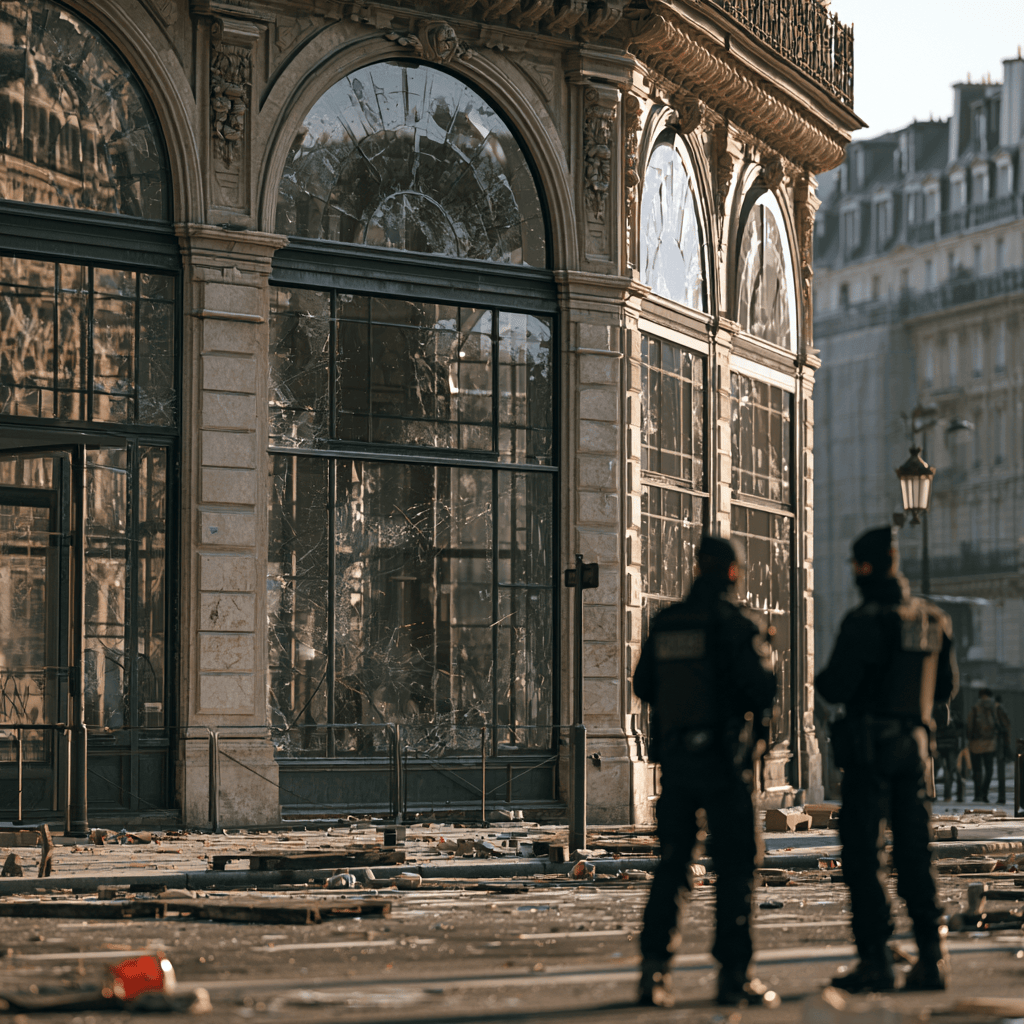
Foreign investors whose shops, hotels, warehouses or other assets were damaged during the October unrest in France may have several routes to compensation: insurance, French state liability and, in qualifying cases, investment-treaty arbitration. The riots do not automatically establish a claim against France. Each investor must identify the applicable legal protection, prove its losses and connect them to the relevant incident.
Reports published on October 18 primarily describe damage inflicted on October 17. They should not be treated as proof that every reported loss occurred over two days. The Fédération du commerce et de la distribution initially estimated that approximately 1,500 businesses were affected, but described the financial assessment as preliminary.
1. Insurance Is Usually the First Route :
A foreign-owned French business should first examine its property, theft, fire, glass-breakage and riot coverage. Business-interruption protection is separate: compensation for closure-related lost gross margin generally depends on the policy’s terms, including whether covered physical damage occurred. Foreign ownership does not itself establish insurance coverage.
The immediate priorities are to notify insurers within the applicable contractual and legal deadlines, preserve evidence before repairs and document emergency expenditure. The claim should distinguish:
- Physical damage to buildings, equipment and inventory.
- Stolen goods.
- Debris removal, security and emergency repairs.
- Business-interruption losses, where covered.
- Deductibles and uninsured losses.
These categories should be assessed against the actual policy, not assumptions that every riot-related expense is insured.
2. French Law May Allow Compensation Without Proving Police Fault :
Article L.211-10 of the French Internal Security Code establishes state liability for damage resulting from crimes or offences committed openly or violently by crowds or gatherings, armed or unarmed, against persons or property. This can be more accessible than an investment-treaty claim because the statutory regime does not generally require proof that police acted negligently.
However, three essential conditions must be established: a criminal offence, open force or violence, and conduct attributable to a qualifying crowd or gathering. The claimant must also establish the resulting damage and causal connection.
The distinction between a gathering and an organized criminal group is crucial. In its decision of October 11, 2023, No. 465591, the Conseil d’État excluded acts committed independently of a demonstration by a group structured solely to commit offences. Related authorities include Société Generali IARD, December 30, 2016, No. 389835, and Ministre de l’intérieur v. Société SANEF, October 28, 2022, No. 451659.
Consequently, a shop looted during a spontaneous escalation around a march may present a different case from a warehouse attacked by a separately organized gang. Whether the demonstration was officially declared is not, by itself, the complete statutory test. Courts examine the circumstances of each incident.
3. Investment Treaties Provide a Separate, Conditional Route :
A qualifying investor may also argue that France breached a treaty obligation to provide full protection and security. But foreign nationality alone is insufficient: counsel must identify an applicable treaty, protected investment, qualifying investor and valid consent to arbitration.
The governing standard is ordinarily due diligence, not an absolute guarantee against violence. A claimant would need evidence that French authorities failed to take reasonable protective measures in the circumstances and that this failure caused compensable losses. The existence of widespread destruction does not establish that failure automatically.
Relevant awards illustrate the contrast:
- Wena Hotels v. Egypt, Award of December 8, 2000: authorities’ failure to prevent known hotel seizures and adequately remedy them supported liability.
- AAPL v. Sri Lanka, Award of June 27, 1990: the tribunal rejected strict liability but found a failure to take reasonable precautions.
- Pantechniki v. Albania, Award of July 30, 2009: the tribunal rejected liability after assessing overwhelming unrest against the state’s circumstances and resources.
For France, ignored specific warnings or documented refusals to respond to identifiable threats could therefore matter more than general newspaper descriptions of “chaos.”
4. EU Investors Face a Major Arbitration Obstacle :
An investor from another EU member state should not assume it can invoke an intra-EU bilateral investment treaty. The Court of Justice’s Achmea judgment established that intra-EU BIT arbitration clauses are incompatible with EU law, and member states subsequently concluded a termination agreement. Domestic courts and insurance remedies therefore remain particularly important for these investors.
Non-EU investors require a separate treaty-by-treaty assessment; their nationality does not guarantee that France has accepted arbitration for the dispute.
5. Build an Incident-Specific Compensation File :
The strongest approach is to assemble a chronology linking the asset, violence, official response and financial consequences. Useful material includes dated photographs, CCTV, complaints, emergency-call records, witness statements, ownership documents, inventory records, repair estimates and accounts supporting interruption losses.
Read also : Tax Management strategies for Digital Nomads
The precise location and timing are especially important because French crowd-liability rules turn on the relationship between the damage and the gathering, while treaty claims focus on reasonable state protection.
Ultimately, the October events may supply the factual basis for compensation—not an automatic entitlement. Insurance and French statutory liability should be assessed alongside any treaty remedy, with care to avoid inconsistent proceedings or double recovery. An affected investor needs French counsel and, where treaty protection is plausible, investment-arbitration advice before choosing a forum.
Our community already has nearly 355,000 readers!
Subscribe to our Telegram channel
Follow us on Telegram, Facebook and Twitter
© Copyright 2026 – Eurasia Business News. Article no. 3216

