
By Paul de Neuville, Paris correspondent, for Eurasia Business News – July 30, 2026. Article no 3035
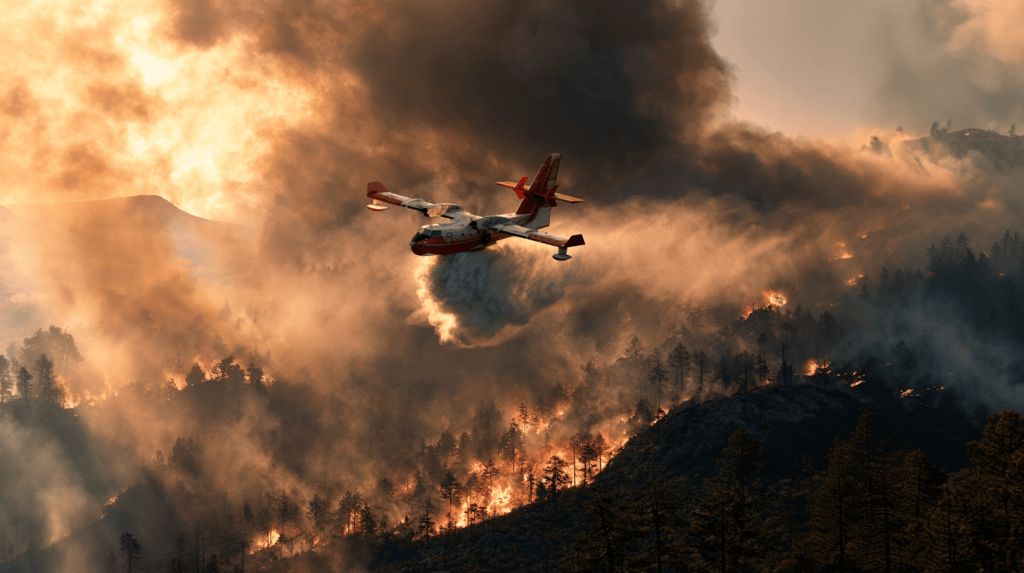
As climate change fuels longer, hotter, and more destructive wildfire seasons, France is relying on just 12 aging Canadair CL-415 water bombers—aircraft that are now around 30 years old on average—to protect millions of people, thousands of homes, and vast natural ecosystems.
The country’s aerial firefighting fleet has become the focus of growing political controversy, exposing what critics describe as years of underinvestment, poor long-term planning, and repeated failures by successive governments to anticipate foreseeable risks.
France’s Wildfire Fleet: Small, Aging, and Frequently Grounded
France’s dedicated aerial firefighting capability depends almost entirely on 12 Canadair CL-415 amphibious aircraft, which remain the backbone of national wildfire response.
Yet these aircraft are showing their age.
After decades of intensive operations, mechanical failures have become increasingly common. Their missions require repeated scooping of seawater—an environment that accelerates corrosion and places exceptional stress on airframes and engines.
The consequences are significant.
A parliamentary report revealed that during parts of the summer of 2024, not a single one of France’s 12 Canadairs was fully operational because of maintenance requirements.
Even during the severe wildfire seasons of 2025 and 2026, only 8 to 11 aircraft were typically available at any given time, substantially reducing France’s ability to attack multiple fires simultaneously.
A Predictable Crisis, Not an Unexpected One
This situation did not emerge overnight.
Production of the CL-415 ended in 2015, making spare parts increasingly difficult and expensive to obtain. Maintenance has become slower and more complex every year.
Critics argue that French authorities have known about these structural weaknesses for years but failed to modernize the fleet before shortages became critical.
Read also : The Private Investor Deal Evaluation Handbook
Firefighter unions, aviation specialists, and several members of Parliament have repeatedly warned that France’s aerial firefighting capacity was becoming increasingly vulnerable.
Those warnings largely went unanswered.
The result is a country entering increasingly dangerous fire seasons with a fleet that is both limited in size and increasingly difficult to keep airborne.
Climate Change Is Accelerating Faster Than Government Planning
Southern France is experiencing more frequent heatwaves, prolonged droughts, and stronger winds that allow fires to spread at unprecedented speed.
The massive fires near Bordeaux, as well as numerous blazes across Mediterranean regions, illustrate how wildfire risk is expanding both geographically and seasonally.
Modern wildfire suppression depends heavily on rapid aerial intervention during the first minutes of a fire.
Every unavailable aircraft can reduce operational flexibility, delay water drops, and force emergency services to prioritize some fires while leaving others to grow.
As fire seasons lengthen, the gap between the scale of the threat and France’s aerial firefighting capacity continues to widen.
New Aircraft Are Coming—But Too Late
France has acknowledged the need for modernization.
In 2024, it joined a European procurement program for the De Havilland DHC-515, the next generation of amphibious water bombers.
France has currently ordered only four aircraft:
- Two through the initial European Union procurement program;
- Two additional aircraft announced in 2026.
However, deliveries remain years away.
The first aircraft are expected between 2028 and 2029, while the remaining two are not scheduled before 2032–2033.
In practical terms, France will continue relying on its aging CL-415 fleet for several more wildfire seasons.
Temporary Solutions Cannot Replace Dedicated Water Bombers
To compensate for shortages, French authorities have experimented with military A400M transport aircraft, temporary leasing arrangements, and private contractors.
While these measures provide additional capacity, none offers the unique operational advantages of dedicated amphibious water bombers capable of performing rapid, repeated water scoops directly from lakes and the Mediterranean Sea.
Read also : The Million-Dollar Retirement Blueprint for U.S. citizens in 2026
These stopgap measures are also more expensive and cannot fully replace a permanent, modern firefighting fleet.
The Political Debate: Failure to Anticipate or Industrial Constraint?
The growing controversy extends well beyond aviation.
Opposition parties accuse successive French governments of systematically underestimating wildfire risk, delaying procurement decisions, and failing to invest early enough in strategic civil protection capabilities.
Their criticism centers on a broader pattern: waiting until infrastructure reaches a critical point before launching replacement programs whose benefits will not materialize for years.
The French Interior Ministry responds that replacement aircraft depend on an international production line that had to be restarted after the original CL-415 ceased production, making earlier deliveries impossible. Officials also point to European cooperation, mutual assistance agreements, and interim measures to reinforce firefighting capacity.
The debate therefore is not simply about the availability of aircraft today. It is also about whether France adequately anticipated a risk that experts, climate scientists, and emergency services had been warning about for years.
In 2024, France’s own two‑aircraft order was canceled via a budget decree (€52.8 million cut from the civil‑security programme), then re‑ordered in June 2026, pushing deliveries from 2028 to 2032. Critics argue this reflects short‑term fiscal constraints rather than technical inability.
In addition, it is difficult to understand why France, once a pioneering country in aviation and technology, is no able to design and manufacture its own water bomber aircraft.
Read also : Tax Management strategies for Digital Nomads
The dependence of France and its European partners on the manufacturer De Havilland Canada, the only manufacturer of certified amphibious water bombers, is particularly worrying in an uncertain geopolitical and climatic context, as the French Senate already raised in its budget report on the 2026 budget bill.
A Strategic Question Beyond Wildfires
Wildfires are no longer exceptional disasters confined to southern Europe.
They are becoming a structural challenge requiring long-term investment, industrial planning, and resilient emergency capabilities.
France’s reliance on a small fleet of aging aircraft illustrates a broader policy dilemma facing many Western democracies: how to prepare critical public infrastructure for predictable future crises rather than reacting once those crises have already arrived.
As climate change continues to intensify wildfire seasons across Europe, the effectiveness of national preparedness will increasingly be measured not by emergency speeches after catastrophic fires, but by the investments governments made years before the first flames appeared.
Our community already has nearly 280,000 readers!
Subscribe to our Telegram channel
Follow us on Telegram, Facebook and Twitter
© Copyright 2026 – Eurasia Business News. Article no. 3035

