
By William Collins, consultant in stock markets – Eurasia Business News, July 30, 2026. Article no 3035
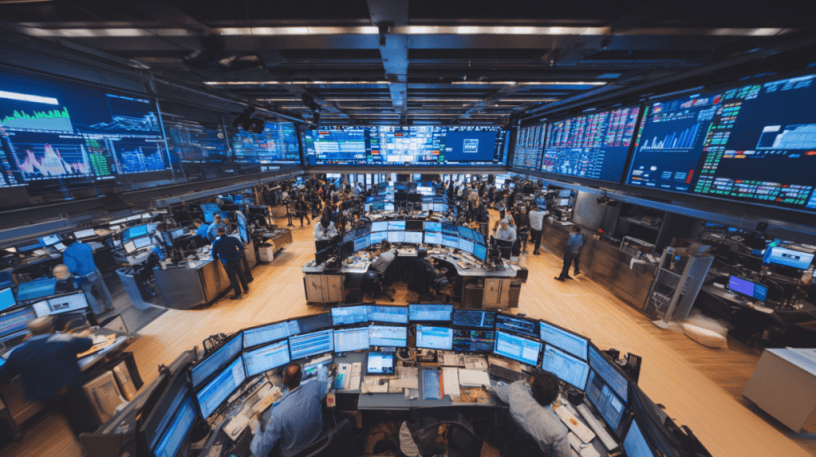
U.S. Treasury yields are advancing further today, reflecting worries about rising inflation and the Fed’s willingness to combat it after officials held interest rates unchanged for a seventh month.
Nasdaq 100 futures (US100:IND) rose +0.50%. S&P 500 futures (SPX) advanced +0.33% and Dow futures (INDU) edged higher by +0.25%.
Microsoft Azure revenue surpasses $100 billion: Microsoft shares (MSFT) jumped 8% in extended trading after the tech giant reported fourth-quarter adjusted earnings of $4.74 per share on revenue of $90 billion, significantly beating Wall Street estimates, which were expecting $4.25 per share and $87.72 billion.
U.S. Treasury yields climbed following a sharp selloff in long-dated bonds. The 10-year Treasury yield (US10Y) rose to 4.70%. The 30-year yield (US30Y) jumped to 5.23%. The 2-year yield (US2Y) slipped slightly to 4.28%.
U.S. stock futures are drifting higher after yesterday’s punishing session. Oil prices are flitting between small gains and losses after the U.S. launched retaliatory strikes against Iran. Brent crude trades roughly $15 higher than before the war started.
Meta Platforms drops on higher AI capex and legal costs: Meta (META) fell over 6% in after-hours trading despite beating revenue estimates with $60.8 billion, as GAAP profit of $6.18 per share missed the $7.19 consensus amid a 55% surge in operating expenses.
Crude oil WTI held above $85 a barrel on Thursday after surging 6.6% in the previous session, amid renewed US military action against Iran.
In early trading, New York gold futures are around $4,065–$4,090 per ounce this morning.
Gold prices tick higher as investors assess comments from Federal Reserve Chairman Kevin Warsh on inflation after the U.S. central bank left interest rates unchanged on Wednesday.
Silver: Approximately $58.13–$58.30 per ounce, on July 30 morning.
Fed Decision: A Divided Hold
The FOMC voted 9-3 to hold the federal funds rate at 3.5%-3.75% for a seventh consecutive meeting on July 29, marking Chair Kevin Warsh’s second meeting at the helm and the first split vote of his tenure. The three dissenters — Beth Hammack, Neel Kashkari, and Lorie Logan — all wanted a 25 bp hike, making this the most dissents since 2016.
Read also : The Million-Dollar Retirement Blueprint for U.S. citizens in 2026
Markets had priced a ~64% probability of a hold going in, with roughly a one-in-three chance of a hike — an unusually uncertain outcome driven by Warsh’s decision to abandon forward guidance. Warsh reportedly doesn’t personally buy the arguments for hikes, raising rates would undermine his task forces, and a hike would put him on the wrong side of Trump administration politics — three reasons he held off.
The September meeting is now the next flashpoint. Investors wager a rate rise is more likely than not in September, and Allianz Global Investors’ Jenny Zeng expects 50 bps of tightening by year-end.
Treasury Sell-Off: 30-Year at 19-Year Highs
The bond market’s response to the divided hold was brutal on the long end:
| Maturity | Yield (July 30) | Move |
|---|---|---|
| 2-year | 4.289% | +5 bps |
| 10-year | 4.70% | +8 bps |
| 30-year | 5.236% | +9+ bps |
The 30-year hit its highest level since July 2007 — just before the global financial crisis — breaching what Wall Street considers the final line of resistance at 5% for the 30-year and 4.5% for the 10-year.
The 2s-30s curve is steepening sharply, with the 30-year trading ~95 bps above the 2-year — a sign the market is pricing in long-term inflation risk without expecting immediate rate action. The 2-year barely moved, reflecting that the near-term rate path was already well-telegraphed.
Oil: War Premium Resurgent
Oil prices climbed after the U.S. launched a “heavy wave” of strikes against Iran late Wednesday in retaliation for missile attacks on American forces, dashing the brief de-escalation hopes from the weekend pause:
- Brent: $92.10/barrel (+1.5%)
- WTI: $85.23/barrel (+0.9%)
The U.S. hit dozens of IRGC targets across Iran — military command centers, missile and drone facilities, coastal defense sites, and maritime capabilities. Iran’s IRGC has threatened further escalation in response.
The trajectory this month has been volatile: Brent briefly hit $100 in late July after 13 consecutive nights of U.S. strikes, then plunged ~7% on a weekend pause that briefly dipped below $90, only to rebound now with the resumption of hostilities. Brent is up more than 50% year-to-date and roughly $15 above pre-war levels, as the user noted.
Read also : The Private Investor Deal Evaluation Handbook
The conflict centers on the Strait of Hormuz, with Iran asserting control and the U.S. imposing a blockade on Iranian ports. Houthi attacks on Saudi tankers in the Red Sea via the Bab el-Mandeb strait have added a secondary supply disruption channel. U.S. gas prices have climbed to $4.10/gallon nationally, up 17+ cents in a month.
Equity Futures: Cautious Bounce
Index futures are recovering modestly after yesterday’s punishing session — Nasdaq 100 +0.50%, S&P 500 +0.33%, Dow +0.25% — but the backdrop is challenging. The combination of 19-year-high long-end yields, resurgent oil prices feeding inflationary pressures, and a Fed that is one dissent away from a hike creates a toxic mix for risk assets.
Read also : Tax Management strategies for Digital Nomads
Our community already has nearly 280,000 readers!
Subscribe to our Telegram channel
Follow us on Telegram, Facebook and Twitter
© Copyright 2026 – Eurasia Business News. Article no. 3036
 Eurasia Business News