
By Anthony Marcus for Eurasia Business News, September 17, 2026. Article n°3169
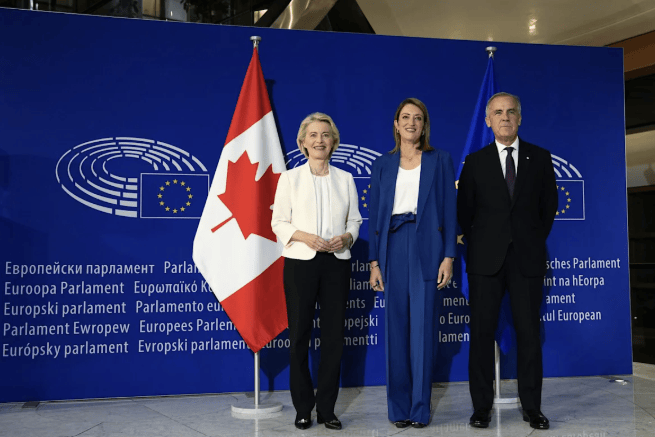
European Commission President Ursula von der Leyen has proposed creating a new relationship between Canada and the European Union that could make Ottawa the bloc’s first “associate member.” The unprecedented plan aims to deepen cooperation in trade, technology, defense, energy and critical minerals as Canada and Europe navigate growing uncertainty in transatlantic relations.
Canadian Prime Minister Mark Carney welcomed the proposal during an address to the European Parliament on Thursday, saying closer ties with Europe would help protect Canada’s sovereignty, economic security and political freedoms. The initiative has already triggered a hostile reaction from U.S. President Donald Trump, who threatened possible tariffs against Europe and Canada.
What the EU Proposal Means
Von der Leyen unveiled the proposal during her annual State of the Union address in Strasbourg, with Carney attending as a special guest. She said Europe wanted to take its relationship with Canada “to the highest level possible” and invited Ottawa to work toward becoming the EU’s first associate member.
The concept is not currently defined in European Union treaties. Unlike full EU membership, associate membership would likely create a structured partnership without giving Canada voting rights in EU institutions or requiring it to adopt all EU laws.
The legal framework, market-access arrangements and political obligations would need to be negotiated. Any agreement would also require approval from the EU’s 27 member states.
The proposal builds on the existing Canada-European Union Comprehensive Economic and Trade Agreement, known as CETA. However, the envisioned partnership would extend well beyond conventional free-trade cooperation.
| Proposed Canada-EU partnership area | Potential focus |
|---|---|
| Trade and investment | Expanded market access and resilient supply chains |
| Technology | Artificial intelligence, advanced manufacturing and digital infrastructure |
| Defense | Industrial cooperation, security coordination and military supply chains |
| Energy | Clean energy, oil, gas and electricity partnerships |
| Critical minerals | Joint access to lithium, nickel, cobalt and rare earths |
| Cybersecurity | Protection of strategic networks and data |
| Arctic cooperation | Security, shipping and resource development |
“Alliance for the Future”
Von der Leyen described the proposed framework as an “Alliance for the Future,” designed to connect European and Canadian economic and security interests more closely. The plan would focus on advanced manufacturing, artificial intelligence, batteries, cybersecurity, defense industries, energy and critical raw materials.
The initiative reflects concerns on both sides of the Atlantic about overdependence on individual trading partners. Canada possesses significant energy and mineral resources, while the EU has a large consumer market, advanced industrial capabilities and extensive regulatory influence.
Closer Canada-EU cooperation could support the development of alternative supply chains for battery materials, semiconductors and defense equipment. It could also help Canada attract European investment as companies seek production locations outside the United States and China.
For Brussels, the proposal represents an effort to strengthen strategic autonomy without abandoning existing transatlantic relationships. For Ottawa, it offers an opportunity to diversify economic and political partnerships at a time when relations with Washington have become more unpredictable.
Carney Welcomes Closer European Ties
Carney said Canada and Europe were stronger together and welcomed the ambition behind von der Leyen’s proposal. He stressed that Canada would remain sovereign and would determine its international partnerships independently.
The Canadian prime minister’s response came amid growing public attention to Ottawa’s relationship with Washington. In his European Parliament remarks, Carney argued that no country should be able to control Canada’s markets, undermine its freedoms or limit its strategic choices.
Although the proposal has political momentum, it remains at an early stage. There is no established process for associate membership, and the EU would need to define what rights and obligations such a status would include.
Trump Threatens Tariffs
The proposal immediately provoked criticism from Trump, who called the idea “laughable” and threatened heavy tariffs against the EU if Brussels moved forward. He also warned that Washington could consider suspending trade with Europe, describing the plan as potentially hostile to the United States.
The European Commission rejected the accusation that the Canada-EU alliance was directed against Washington. Brussels said the initiative was intended to strengthen cooperation among like-minded partners, not to target the United States.
The dispute nevertheless exposes broader tensions in the transatlantic trading system. Canada, the EU and the United States remain deeply integrated through trade, investment and defense links. Any new Canada-EU arrangement that appears to weaken Washington’s influence could produce pressure on businesses and complicate negotiations over tariffs and market access.
Strategic Importance for Europe and Canada
The proposed Canada-EU associate membership could become a model for a new category of international partnership. It would allow the EU to build deeper relationships with non-European democracies without offering full membership.
The idea also reflects a changing global environment. Europe and Canada face common challenges involving energy security, supply-chain resilience, China’s industrial rise, Arctic competition and uncertainty over U.S. policy.
Whether the proposal becomes a formal agreement remains uncertain. But von der Leyen’s invitation and Carney’s positive response mark a significant step toward a closer Canada-EU alliance—and a potential reshaping of transatlantic trade and security relations.
Ursula von der Leyen’s second term as head of the European Commission ends in 2029 (usually at the end of November or December 2029, at the end of his five-year term of office starting on 1 December 2024).
Our community already has nearly 330,000 readers!
Subscribe to our Telegram channel
Follow us on Telegram, Facebook and Twitter
© Copyright 2026 – Eurasia Business News. Article no. 3169

